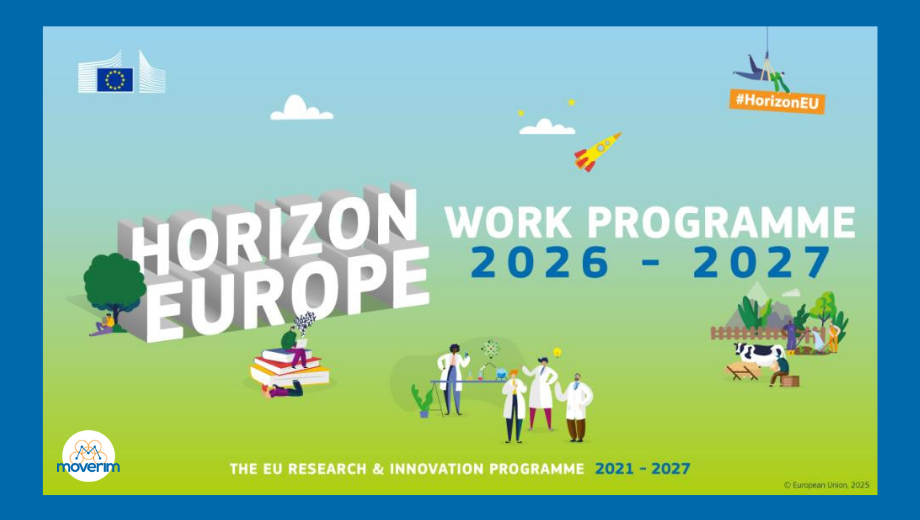
The European Commission has officially adopted the new Horizon Europe Work Programme 2026–2027, the final programme of the 2021–2027 funding period. With an overall investment of more than €14 billion, the programme reaffirms the EU’s commitment to placing R&I at the heart of Europe’s economic growth, sustainability, and global competitiveness.
The 2026–2027 work programme introduces new strategic initiatives, stronger alignment with EU policy priorities and a reinforced focus on green and digital transitions, industrial competitiveness, artificial intelligence, security, and talent attraction. The programme aims to deliver high-impact solutions through interdisciplinary research, cross-sector collaboration and closer links between research excellence and market deployment.
A New Feature: Horizontal Calls
One of the key innovations of the new Work Programme is the introduction of horizontal calls, a new funding approach designed to address major EU policy priorities through cross-cluster, multidisciplinary and industry-led actions. The horizontal calls aim to better align Horizon Europe with evolving EU policies by tackling them in a comprehensive manner; therefore, they focus on broadly defined topics with a shared strategic direction, providing applicants the flexibility to propose various approaches to achieve the expected outcomes. These calls are open and bottom-up, allowing diverse technological and systemic solutions while creating critical mass and accelerating innovation.
A flagship example is the Horizontal Call supporting the Clean Industrial Deal, with an indicative budget of around € 600 million. The call aims to develop a new generation of fit-for-deployment demonstrators in clean technologies and decarbonised industry, combining technological excellence with strong market readiness and credible business models.
Focusing on Clean Tech for Climate and the Decarbonisation of Energy-Intensive Industries, the call supports Europe’s climate neutrality objectives, industrial competitiveness and strategic autonomy. Through stronger coordination across clusters and with instruments like the Innovation Fund, Horizontal Calls bridge the gap between research and large-scale deployment.
The Horizon Europe 2026-2027 Work Programme introduces two significant horizontal calls aimed at advancing key EU policy goals. The “R&I in Support of the Clean Industrial Deal” call, with a budget of €540 million, focuses on accelerating the market deployment of clean technologies and decarbonisation solutions for energy-intensive industries, fostering industry-led, cross-sector innovation. The “AI in Science” call, with an indicative budget of €90 million, contributes to the Resource for AI Science in Europe (RAISE) initiative and strengthens Europe’s leadership in AI-driven scientific discovery. It aims to support trustworthy and ethical AI applications across sectors like agriculture, advanced materials, and the environment, contributing to Europe’s digital transition and enhancing R&I leadership. Both calls emphasise the need for market-ready, scalable solutions that align with EU sustainability and innovation objectives.
Attracting Talent: Choose Europe for Science
The Choose Europe for Science initiative is a central pillar of the 2026–2027 Work Programme, aiming to make Europe a leading destination for research careers, which promotes stable career paths, excellent working conditions and access to world-class research infrastructures.
Key actions include:
- €50 million under the Marie Skłodowska-Curie Actions (MSCA) to support long-term fellowships, postdoctoral stability and relocation incentives;
- investments in Research Infrastructures to improve transnational access, training and international cooperation;
- €240 million for ERA Chairs, attracting top researchers to underperforming regions;
- support for startups and scaleups through the European Innovation Ecosystems, fostering the growth of deep-tech companies.
Horizon Europe 2026: Key Changes to Boost Innovation and Competitiveness
The Horizon Europe Work Programme 2026 introduces several key changes aimed at strengthening innovation and aligning with the EU’s strategic priorities. One of the most significant innovations is the pilot of the Advanced Innovation Challenges (AIC), designed to reinforce risk-taking and user uptake of innovations. This two-stage funding model allows applicants to propose solutions in the first stage, with a select number of projects advancing to implementation in the second stage in 2027. Other notable changes include an increase in the indicative budget for EIC Pathfinder projects to €4 million, aimed at supporting proof-of-concept developments, and a simplification of the EIC Accelerator evaluation process, allowing for faster investment decisions. The programme also strengthens Business Acceleration Services, particularly for internationalisation and engagement with corporates, in line with the Startup and Scaleup Strategy. Additionally, the EIC STEP Scaleup and EIC Transition calls are refined to better support the scaling of innovative technologies and their market readiness. These changes, along with enhanced collaboration with the European Institute of Innovation and Technology (EIT), reflect a comprehensive approach to accelerating Europe’s innovation ecosystem and reinforcing its competitive edge in global markets. Overall, the programme positions Europe to lead in the green and digital transitions, boosting economic resilience and industrial competitiveness.
A significant innovation in the new Work Programme, as mentioned above, is the introduction of the Advanced Innovation Challenges (AIC) pilot by the European Innovation Council (EIC), which represents a new funding instrument designed to support high‑risk, demand‑driven deep tech innovation with transformative potential in areas where Europe leads in research but struggles to bring breakthroughs to market. The AIC adopts a two‑stage, where projects are evaluated and selected at each stage: Stage 1 offers a lump sum to prepare and benchmark breakthrough solutions, while Stage 2 provides larger funding to further develop and test the most promising projects, with active involvement of end users and ecosystem actors, to accelerate real‑world deployment and uptake. Driven by EIC Programme Managers and shaped in collaboration with users and stakeholders, the AIC aims to bridge the gap between research and commercial application and enhance the efficiency and impact of deep tech innovation in Europe.
Simplification Measures for Greater Accessibility, Flexibility, and Impact
The Horizon Europe Work Programme 2026-2027 also introduces significant simplification measures aimed at improving accessibility and efficiency. Consequently, key changes include less prescriptive topic descriptions, allowing more flexibility for applicants to approach the challenges in diverse ways. The number of topics has been reduced by 35%, focusing resources on fewer but larger and more impactful topics. Additionally, 50% of the funding will be implemented through lump sums, simplifying financial management and reducing the administrative burden. The programme also introduces ‘newcomer-friendly’ and SME-friendly topics, encouraging greater participation from startups, SMEs, and civil society organisations. Moreover, the use of two-stage calls has been expanded, enabling shorter first-stage proposals and quicker evaluations, while the proposal templates have been simplified to reduce complexity and page limits. These changes are designed to make the work programme more efficient, inclusive, and impactful, supporting a broader range of participants and speeding up the time to grant.
A Strategic Programme for Europe’s Future
With the Horizon Europe Work Programme 2026–2027, the EU confirms its strategic choice to invest in science, technology and innovation as key drivers of sustainable prosperity, resilience and competitiveness. Thus, by combining excellence, impact and openness, the programme provides a unique opportunity for researchers, companies and public actors to contribute to shaping Europe’s future.
For more information on Horizon Europe and the current Work Programme 2026-2027, click here.