
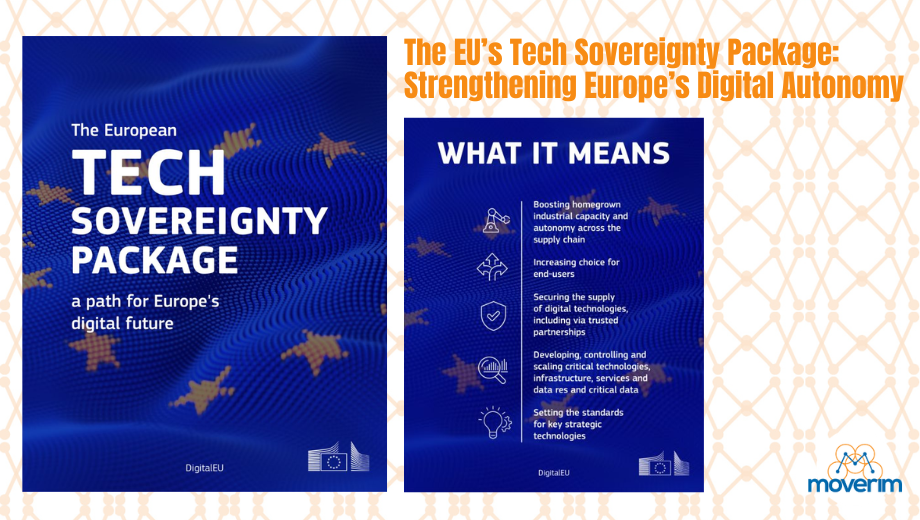
On 3 June 2026, the European Commission presented the European Technological Sovereignty Package, a set of measures designed to strengthen Europe’s capacity in strategic digital technologies such as semiconductors, artificial intelligence, cloud infrastructure and open source.
The package reflects a growing EU priority: ensuring that Europe can develop, deploy and govern critical technologies while reducing strategic dependencies. As digital technologies become increasingly central to public services, industrial competitiveness, research and energy systems, technological sovereignty is becoming a key condition for Europe’s resilience and long-term innovation capacity.
What does the package include?
The initiative brings together four main elements.
The Chips Act 2.0 aims to reinforce Europe’s semiconductor ecosystem by supporting investment, strengthening supply chains and connecting chip development more closely with industrial demand. This is particularly relevant for sectors such as AI, robotics, connected vehicles, cloud services and advanced manufacturing.
The Cloud and AI Development Act focuses on expanding Europe’s capacity in cloud and AI technologies. It aims to support research and innovation, facilitate the deployment of sustainable data centres and introduce a common EU framework to assess cloud and AI sovereignty. This is closely linked to the EU’s ambition to become a leading AI continent.
A third pillar is the EU Open Source Strategy, which promotes open, interoperable and reusable digital solutions, especially in public administrations. By supporting open standards and cooperation with open-source communities, the Commission aims to reduce vendor lock-in and strengthen Europe’s digital autonomy.
Finally, the Strategic Roadmap for Digitalisation and AI in Energy addresses the growing interdependence between digital infrastructure and the energy system. It focuses on the sustainable integration of data centres, the use of AI and digital tools for grids and energy efficiency, and secure cross-border data sharing.
Why it matters for innovation stakeholders
The Tech Sovereignty Package is highly relevant for Europe’s research and innovation ecosystem. It connects digital autonomy with industrial policy, sustainable infrastructure, public procurement and future technology development.
For researchers, SMEs, start-ups, public administrations and regional ecosystems, the initiative highlights key areas of growing relevance: artificial intelligence, semiconductors, cloud infrastructure, open-source technologies, cybersecurity, smart grids and digital solutions for the energy transition.
It also shows that technological sovereignty is not only about reducing external dependencies. It is about building European capacity to create and use critical technologies in ways that support competitiveness, sustainability and public value.
Looking ahead
The success of the package will depend on implementation, investment and cooperation between EU institutions, Member States, industry and research organisations. Its measures will need to translate into concrete opportunities for innovators, public actors and technology providers across Europe.
More broadly, the package confirms that digital autonomy is becoming a structural priority for the EU. In the coming years, the ability to combine technological capacity, sustainability and resilience will play an increasingly important role in Europe’s innovation agenda.
For further information, click here.