
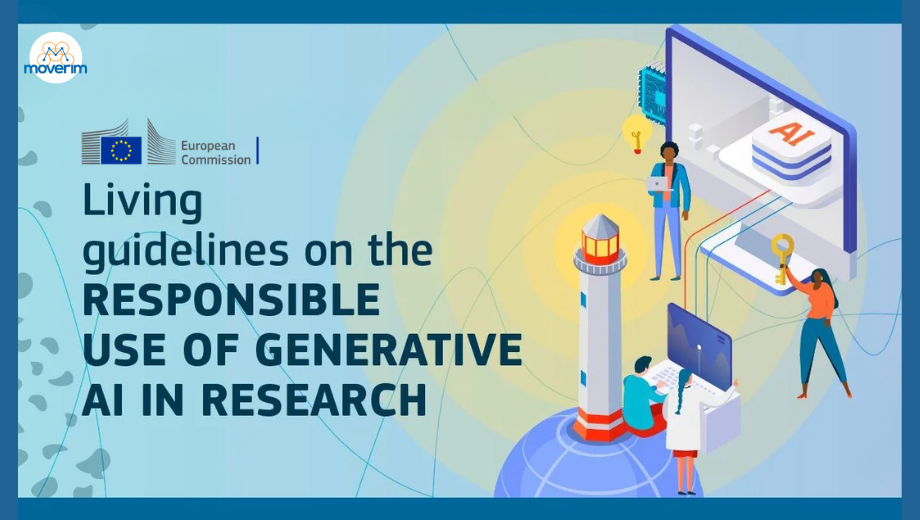
The European Commission has recently published an updated version of the ERA Living Guidelines on the responsible use of Generative AI in research, offering practical recommendations for researchers, research organisations and funding bodies across the European Research Area (ERA).
The update reflects the rapid evolution of generative AI tools and their growing presence in research activities, from literature reviews and data analysis to proposal writing, communication, project management and evaluation processes. The objective remains clear: to help Europe’s research community benefit from AI while safeguarding scientific integrity, transparency, accountability and trust.
Why is AI important in science?
AI is increasingly reshaping scientific research, influencing the way research is designed, carried out and communicated. Generative AI tools can support researchers by accelerating access to information, improving productivity, assisting with data analysis and opening paths to discoveries that were previously difficult to achieve.
For Europe, the use of AI in science is also part of a wider effort to support responsible innovation and the trustworthy integration of digital technologies into research and innovation systems. Europe’s approach therefore seeks to balance the opportunities offered by AI with the need to preserve research integrity, transparency and public trust.
At the same time, the use of AI in research raises important questions around transparency, accountability, confidentiality and research integrity. The updated ERA Living Guidelines aim to address these issues through a practical and principle-based approach, supporting the research community in using generative AI while protecting the credibility and trustworthiness of science.
The new guidelines:
The revised guidelines maintain their simple and operational format, while adapting key research integrity principles, such as reliability, honesty, respect and accountability, to the current use of generative AI.
A key element of the update concerns the use of AI by external parties. Researchers and organisations are encouraged to remain aware that third parties may use AI tools during meetings, document reviews or information-management processes, for example to record, transcribe, summarise or process discussions and documents. This is particularly relevant when sensitive or confidential research information is involved. In such cases, AI tools may process data without all participants being fully aware of the potential implications for privacy, confidentiality, data protection or intellectual property rights. The guidelines therefore call for greater transparency and appropriate safeguards when AI tools are used in collaborative or institutional settings.
Another important update concerns the risk of “hidden prompts”. These are invisible or secretly embedded instructions designed to influence the behaviour of AI systems. For example, hidden prompts could be inserted into documents with the aim of pushing an AI tool toward a more favourable assessment. This issue is especially relevant in research funding and evaluation processes, where fairness, independence and scientific judgement must be protected. The guidelines underline that the use of AI should never undermine human responsibility or the integrity of assessment procedures.
The “living” nature of the guidelines is therefore particularly relevant in the context of generative AI, where technologies and research practices continue to evolve quickly. Regular updates allow the guidelines to reflect new developments, emerging risks and practical experience from the research community, while maintaining a consistent focus on research integrity, transparency and accountability. In this way, they continue to serve as a valuable resource for researchers, organisations and funding bodies.